Case Study: Public Meal Plan Templates
How the 100% AI-Driven Workflow transformed a vague product idea into a production-ready feature in 20-30 minutes.
Table of Contents
- The Challenge
- Phase-by-Phase Breakdown
- Workflow Impact Analysis
- What Would Have Gone Wrong Without the Workflow
- Artifacts Inventory
- Screenshots
The Challenge
Starting Point: A vague product requirement: "Users should be able to share their meal plans with others."
End Goal: A complete feature with database schema, API, UI, tests, and documentation.
Traditional Approach Problems:
- Jump straight to coding → miss edge cases
- Build UI first → API doesn't match
- Skip documentation → context lost for future work
- Forget testing → bugs in production
Workflow Solution: Structured phases that build on each other, with documentation generated during development.
Phase-by-Phase Breakdown
Phase 0: Input
Purpose: Provide the AI with raw requirements so it has context for what to build.
What Was Provided
Users want to:
- Save their weekly meal plans as reusable templates
- Name and describe templates
- Apply templates to any week
- Optionally share templates publicly
- Import other users' templates into their own planner
Impact of This Phase
| Without Input | With Input |
|---|---|
| AI guesses what "share meal plans" means | AI understands the complete user story |
| Generic feature that might not fit | Targeted solution matching user needs |
| Multiple clarification rounds needed | One-shot design that's 90% correct |
Phase 1: UX Product Thinking
Purpose: Transform vague requirements into a comprehensive, documented design.
What the Workflow Did
-
User Research (project-goose.ca artifact)
- Used existing user research from project-goose.ca as the foundation before implementing the UX
- See the full research report: Mise En Place Market Research
- This informed ICP definitions, pain points, and feature prioritization
-
Competitive Research (Tavily MCP)
- Searched: "meal planning app templates feature"
- Analyzed: Plan to Eat, Prepear, Paprika, Samsung Food
- Identified gap: No one does peer-to-peer meal plan sharing with YouTube video integration
-
Defined Ideal Customer Profiles (ICPs)
ICP Fit Score Primary Pain Point YouTube Recipe Enthusiast 72/100 "I want to share curated video recipe collections" Overwhelmed Meal Planner 68/100 "No time to plan from scratch each week" Analog Recipe Archivist 58/100 "Family recipes should be preserved and shared" -
Created User Flows (Mermaid diagrams)
-
Designed Data Model (ER diagram)
Three tables identified:
meal_plan_template— Template metadata + visibilitymeal_plan_template_entry— Meal assignmentsmeal_plan_template_import— Track who imported what
-
Drew ASCII Wireframes
┌─────────────────────────────────────────────────────────┐
│ ✕                    Save as Template                   │
├─────────────────────────────────────────────────────────┤
│  Template Name *                                        │
│  ┌─────────────────────────────────────────────────┐   │
│  │ Mediterranean Week                               │   │
│  └─────────────────────────────────────────────────┘   │
│                                                         │
│  Description                                            │
│  ┌─────────────────────────────────────────────────┐   │
│  │ Fresh, healthy Mediterranean meals...            │   │
│  └─────────────────────────────────────────────────┘   │
│                                                         │
│  Theme Tag                                              │
│  ┌─────────────────────────────────────────────────┐   │
│  │ Mediterranean ▼                                  │   │
│  └─────────────────────────────────────────────────┘   │
│                                                         │
│           [ Cancel ]        [ Save Template ]           │
└─────────────────────────────────────────────────────────┘
Artifact Created
docs/features/public-meal-plans-architecture.md — 847 lines covering:
- Competitive positioning (quadrant chart)
- User flows (3 Mermaid diagrams)
- Data model (ER diagram + TypeScript interfaces)
- Feature breakdown (5 features with acceptance criteria)
- ASCII wireframes (2 screens)
- API endpoints (8 routes)
- Migration SQL
Impact of This Phase
| Without UX Product Thinking | With UX Product Thinking |
|---|---|
| Data model designed during coding | Data model designed upfront, validated |
| UI invented on the fly | Wireframes guide component structure |
| Edge cases discovered in production | Edge cases identified in flows |
| No record of design decisions | Architecture doc captures reasoning |
| ~4 hours of back-and-forth | ~5 minutes of structured design (with project-goose research) |
Phase 2: Frontend Design
Purpose: Ensure the UI is distinctive, not generic "AI slop."
What the Workflow Did
Embedded in the architecture doc, the design spec defined:
Aesthetic Direction:
- Tone: "Editorial cookbook meets weekly planner—warm, organized, inspiring"
- Memorable Element: "The compact 7-day visual grid that shows meal thumbnails at a glance"
Typography:
| Usage | Font | Weight |
|---|---|---|
| Template name | Playfair Display | 600 (semibold) |
| Description | Source Sans 3 | 400 (regular) |
| Stats/badges | Source Sans 3 | 500 (medium) |
Color Palette:
| Token | Usage |
|---|---|
var(--background) | Page background |
var(--card) | Template cards, week grid |
var(--primary) | Import button, active states |
var(--secondary) | Theme tags, stat badges |
Motion Design:
- Card hover: Subtle lift (
translateY(-2px)) with shadow increase - Import success: Checkmark animation
- Grid reveal: Staggered fade-in for meal thumbnails
Artifact Created
Design spec section in docs/features/public-meal-plans-architecture.md, plus 3 UI concept images generated for different ICPs.
Impact of This Phase
| Without Frontend Design Phase | With Frontend Design Phase |
|---|---|
| Inter font (default AI choice) | Playfair Display (distinctive) |
| Purple gradients (generic AI aesthetic) | Warm terracotta + sage (project palette) |
| No motion design | Intentional animations defined |
| Hardcoded colors in components | CSS variables for theming |
Phase 3: Plan with Subagents
Purpose: Break the feature into tasks and assign each to the right specialist.
What the Workflow Did
Created implementation order following data flow:
1. SCHEMA (generalPurpose)
   ↓
2. REPOSITORY (generalPurpose)
   ↓
3. tRPC ROUTES (generalPurpose)
   ↓
4. UI COMPONENTS (generalPurpose)
   ↓
5. ROUTE PAGES (generalPurpose)
   ↓
6. LOGGING (logger)
   ↓
7. TESTING (tester)
   ↓
8. DOCUMENTATION (context-keeper + architecture-tracker)
Task Assignments
| Task | Subagent | Why This Subagent |
|---|---|---|
| Database schema + migration | generalPurpose | Standard code generation |
| Repository layer (~980 lines) | generalPurpose | CRUD + complex queries |
| tRPC routes (~300 lines) | generalPurpose | API with Zod validation |
| UI components (5 files) | generalPurpose | React + Tailwind |
| Route pages (3 files) | generalPurpose | Page-level composition |
| Debug logging | logger | Knows logging patterns |
| E2E tests + screenshots | tester | Has Playwright MCP |
| Update context.md | context-keeper | Documentation specialist |
| Update architecture doc | architecture-tracker | Tracks route maps |
Impact of This Phase
| Without Planning | With Planning |
|---|---|
| UI built before API exists | API ready when UI needs it |
| Logging forgotten | Logging is an explicit task |
| Tests written last (or never) | Tests are part of the plan |
| Docs become stale | Docs updated as final tasks |
Phase 4: Implement Feature
Purpose: Execute the plan by delegating to subagents in the right order.
What Was Built
Database (Migration 0008):
CREATE TABLE `meal_plan_template` (
  `id` text PRIMARY KEY NOT NULL,
  `created_by_id` text NOT NULL,
  `name` text NOT NULL,
  `slug` text NOT NULL,
  `description` text,
  `theme` text,
  `is_public` integer DEFAULT false NOT NULL,
  `import_count` integer DEFAULT 0 NOT NULL,
  `view_count` integer DEFAULT 0 NOT NULL,
  ...
);

CREATE TABLE `meal_plan_template_entry` (...);
CREATE TABLE `meal_plan_template_import` (...);
Repository (app/repositories/meal-plan-template.ts):
createTemplate()— Copy entries from meal planupdateTemplate()— Change visibility, metadatadeleteTemplate()— Cascade delete entrieslistUserTemplates()— Get user's templatesgetPublicTemplateBySlug()— Fetch with grocery aggregationimportTemplate()— Clone to user's planner
tRPC Routes (app/trpc/routes/meal-plan-template.ts):
| Route | Type | Purpose |
|---|---|---|
create | mutation | Save current week as template |
update | mutation | Edit name, description, visibility |
delete | mutation | Remove template |
list | query | Get user's templates |
getBySlug | query | Public template by username/slug |
listPublic | query | User's public templates |
import | mutation | Clone template to user's week |
incrementViewCount | mutation | Track views |
UI Components (app/components/meal-plan-template/):
| Component | Purpose |
|---|---|
template-card.tsx | Card with stats, visibility toggle, actions |
save-template-modal.tsx | Form to save current week |
import-modal.tsx | Week selector for importing |
week-preview-grid.tsx | Compact 7-day grid |
index.ts | Barrel exports |
Route Pages:
| Route | File |
|---|---|
/recipes/templates | My Templates management |
/u/:username/plans | Public plans list |
/u/:username/plans/:slug | Single public plan |
Impact of This Phase
| Ad-Hoc Implementation | Workflow Implementation |
|---|---|
| Components made up on the fly | Components match wireframes |
| Data flow unclear | Repository handles all data access |
| Inconsistent error handling | Custom error classes throughout |
| No type safety | Zod validation + TypeScript |
Phase 5: Create Pull Request
Purpose: Package all work into a properly formatted PR.
What Was Validated
The pr-checker skill verified:
- ✅ Repository pattern followed (Database type alias, try-catch)
- ✅ tRPC routes use Zod validation
- ✅ Routes registered in
app/routes.ts - ✅ Migration uses snake_case naming
- ✅ Testing plan exists
- ✅ context.md updated
- ✅ Screenshots captured
Artifacts for PR
| Artifact | Purpose |
|---|---|
docs/testing/public-meal-plans/public-meal-plans.md | Test scenarios + results |
docs/testing/public-meal-plans/screenshots/*.png | Visual evidence |
Updated .cursor/context.md | Feature list |
Updated .cursor/context/data-models.md | New tables documented |
Updated .cursor/context/high-level-architecture.md | New routes |
Impact of This Phase
| Without PR Workflow | With PR Workflow |
|---|---|
| "What does this PR do?" questions | Self-documenting PR |
| Reviewers find issues manually | Pre-validated against patterns |
| No screenshots | Visual proof included |
| Context.md stale | Automatically updated |
Workflow Impact Analysis
Time Comparison
| Approach | Estimated Time | Quality |
|---|---|---|
| Traditional (jump to code) | 6-8 hours | Needs rework, missing docs |
| Ad-hoc AI (no workflow) | 3-4 hours | Inconsistent, gaps |
| 100% AI Workflow | ~20-30 min | Production-ready, documented |
Phase Timing Breakdown
| Phase | Time | Artifact |
|---|---|---|
| Input | 1 min | Requirements captured |
| UX Product Thinking | 5 min | 847-line architecture doc (leveraged project-goose research) |
| Frontend Design | (included above) | Design spec section |
| Planning | 2 min | Task list with subagent assignments |
| Implementation | 10 min | ~1,800 lines of code |
| Testing | 5 min | 18 E2E tests + screenshots |
| PR Preparation | 2 min | Validation + context updates |
| Total | ~25 min | Complete feature |
Lines of Code Generated
| Category | Lines | Files |
|---|---|---|
| Repository | ~980 | 1 |
| tRPC Routes | ~300 | 1 |
| UI Components | ~800 | 5 |
| Route Pages | ~600 | 3 |
| Migration | 36 | 1 |
| Tests | ~250 | 1 |
| Documentation | ~1,200 | 4 |
| Total | ~4,166 | 16 |
What Would Have Gone Wrong Without the Workflow
Problem 1: Missing Route Registration
What happened: Routes returned 404 after creating files.
Root cause: React Router in this project uses manual route configuration, not file-based routing.
How the workflow helped: The architecture doc included a "New Files" section that reminded to update app/routes.ts. This was almost missed anyway, but the pattern was documented.
Lesson: The workflow's documentation-first approach captures project-specific patterns that the AI might not remember.
Problem 2: Data Model Changes During Implementation
What didn't happen (because of the workflow): Usually, you discover midway through implementation that your data model is wrong.
How the workflow prevented this: Phase 1 created the ER diagram and TypeScript interfaces before any code was written. The import tracking table (meal_plan_template_import) was identified upfront, not discovered as a "oh we need to track this" afterthought.
Problem 3: Generic UI
What didn't happen: The UI could have been generic Inter font with purple gradients.
How the workflow prevented this: The Frontend Design phase specified:
- Playfair Display for headings
- Warm terracotta + sage palette
- Specific motion design
The generalPurpose subagent read this spec before generating UI code.
Problem 4: Forgotten Documentation
What didn't happen: Documentation usually becomes "we'll write it later" (and never does).
How the workflow ensured it:
- Phase 1 creates the architecture doc first
- Phase 4 includes
context-keeperandarchitecture-trackeras explicit tasks - PR creation validates that docs are updated
Artifacts Inventory
Documentation Created
| File | Lines | Purpose |
|---|---|---|
docs/features/public-meal-plans-architecture.md | 847 | Full architecture + design spec |
docs/testing/public-meal-plans/public-meal-plans.md | 219 | Test plan + results |
.cursor/context/data-models.md (updated) | +15 | New tables documented |
.cursor/context/features.md (updated) | +20 | Feature description |
.cursor/context/high-level-architecture.md (updated) | +10 | New routes |
Code Created
| File | Lines | Purpose |
|---|---|---|
drizzle/0008_add_meal_plan_templates.sql | 36 | Migration |
app/db/schema.ts (updated) | +50 | Table definitions |
app/repositories/meal-plan-template.ts | 985 | Data access layer |
app/trpc/routes/meal-plan-template.ts | 312 | API routes |
app/components/meal-plan-template/*.tsx | 802 | UI components (5 files) |
app/routes/recipes/templates.tsx | 189 | My Templates page |
app/routes/u.[username].plans.tsx | 156 | Public plans list |
app/routes/u.[username].plans.[slug].tsx | 287 | Public plan detail |
e2e/public-meal-plans.spec.ts | 248 | E2E tests |
Visual Assets
| Folder | Count | Purpose |
|---|---|---|
docs/testing/public-meal-plans/screenshots/ | 70+ | Test evidence |
public/docs/features/public-meal-plans/ | 3 | UI concept images |
Screenshots
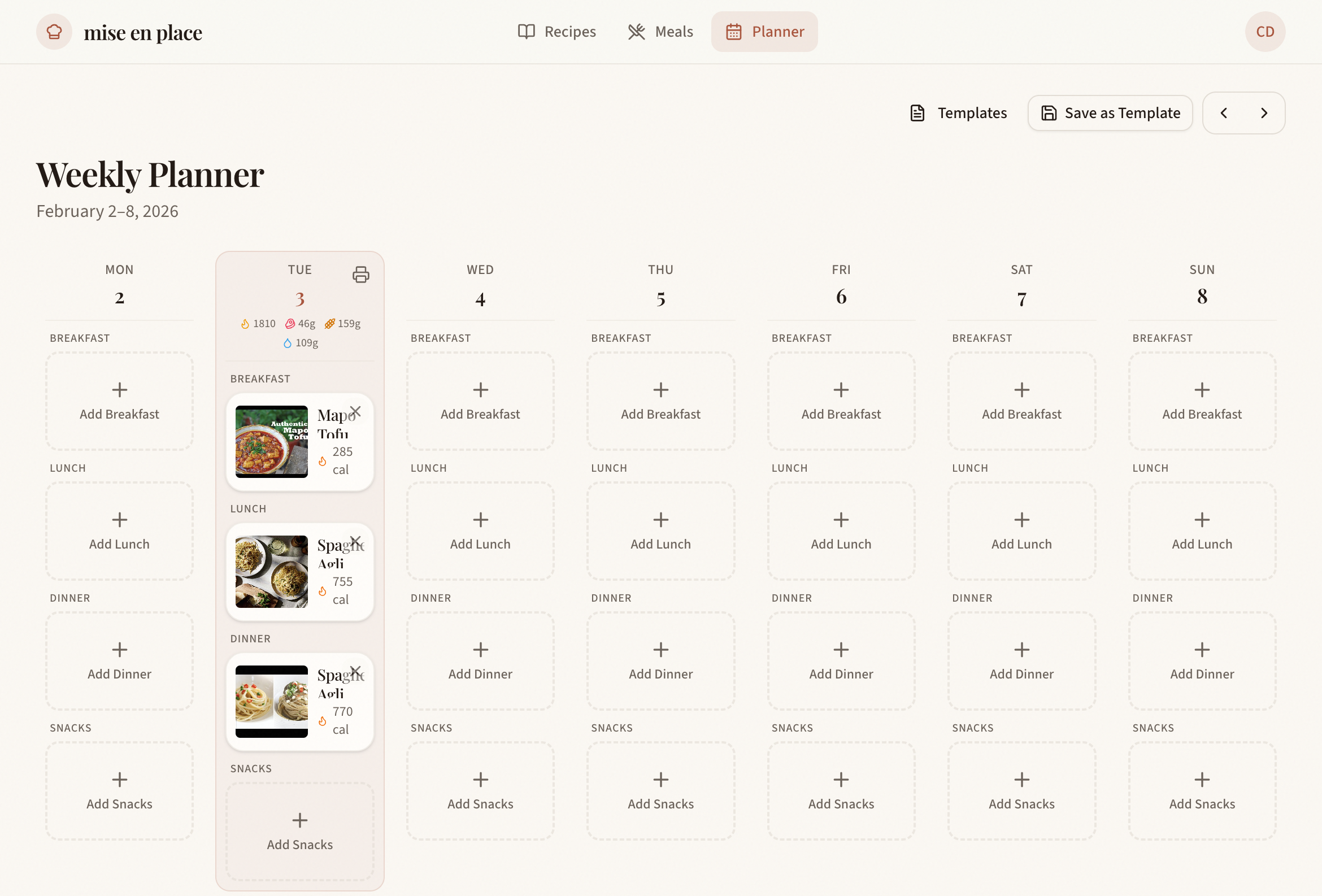
Weekly Planner Integration
The planner now shows "Templates" link and "Save as Template" button (appears when 3+ meals are planned):
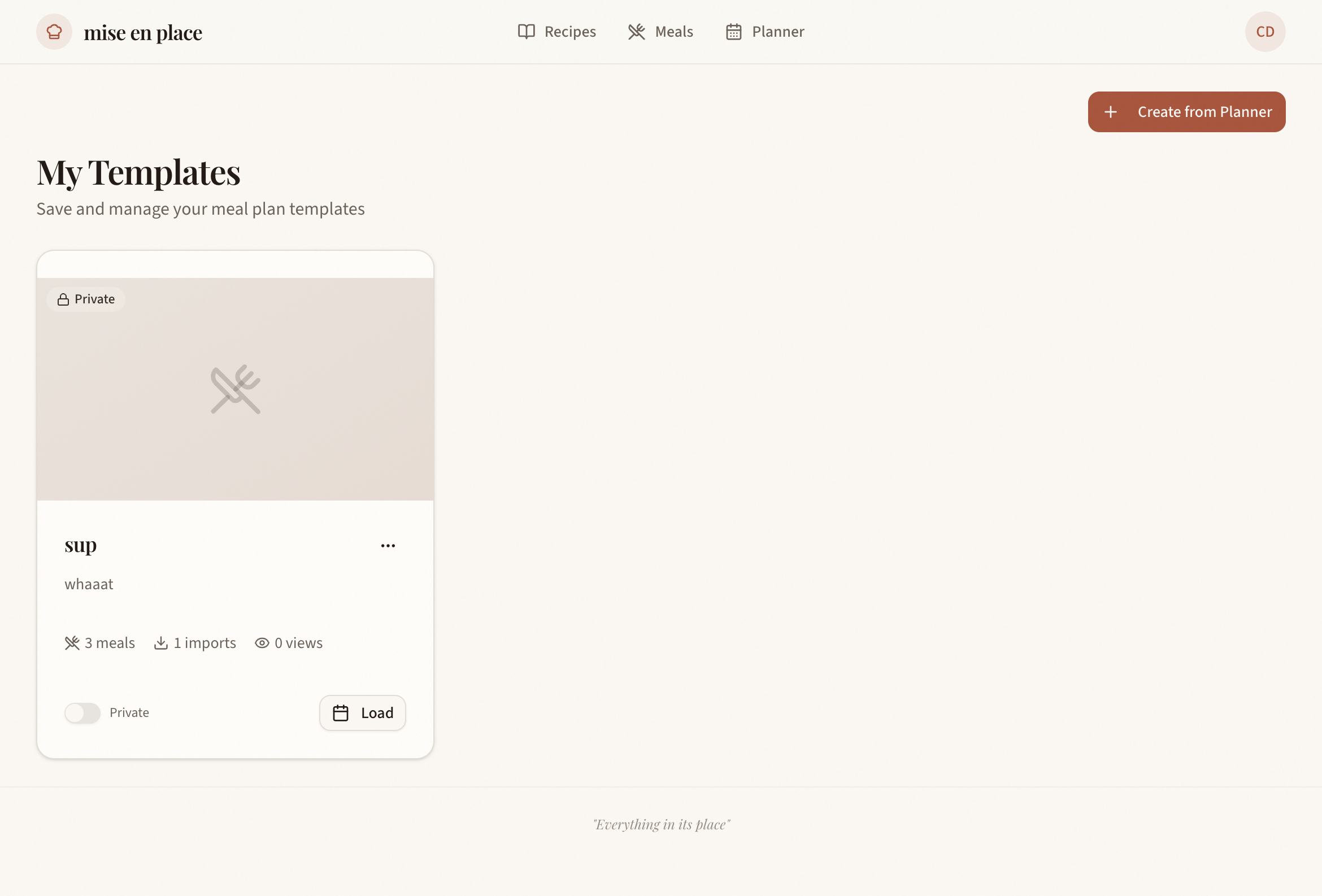
My Templates Page
Template cards show stats (meals, imports, views), visibility toggle, and Load button:
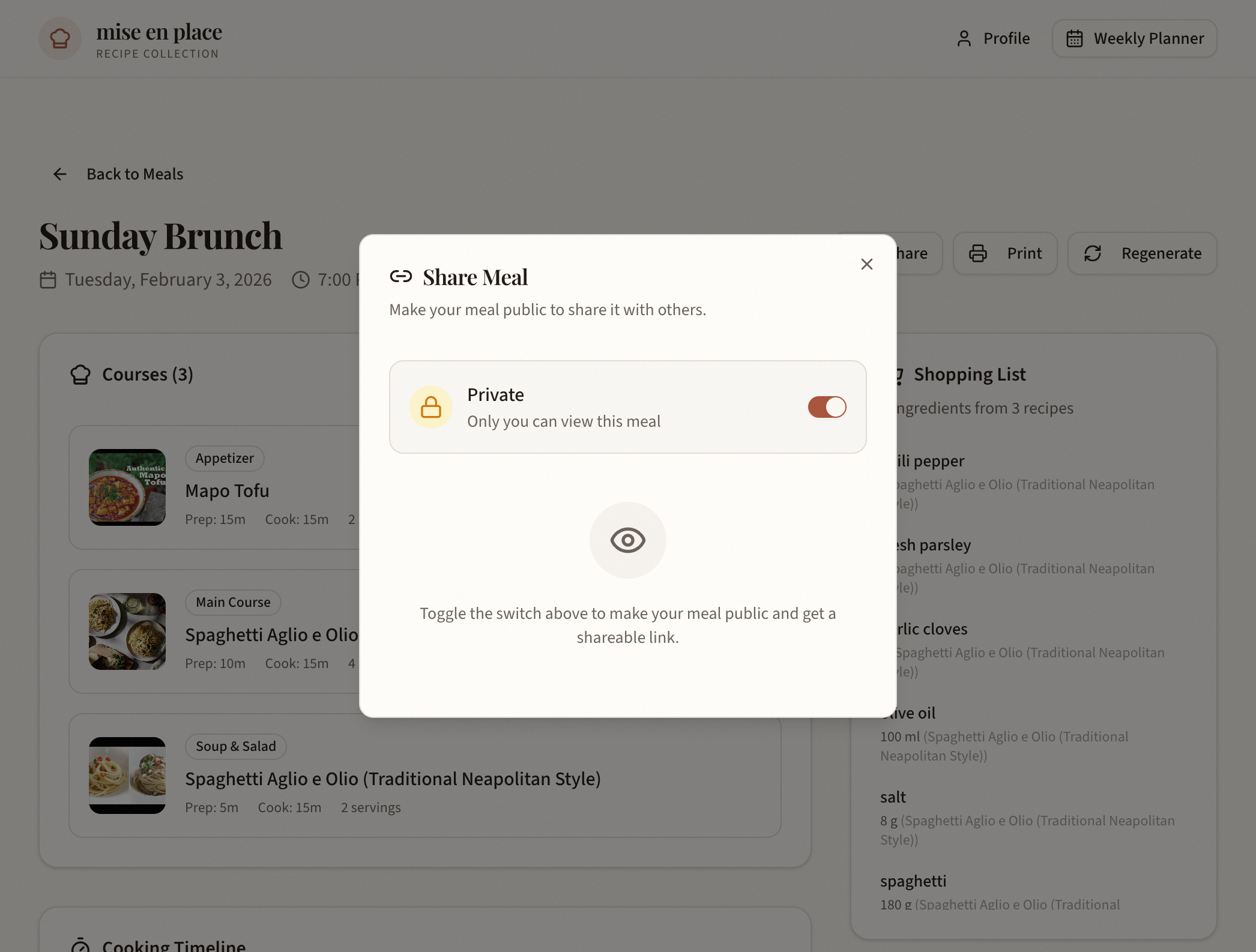
Share Modal
Toggle to make template public and get shareable link:
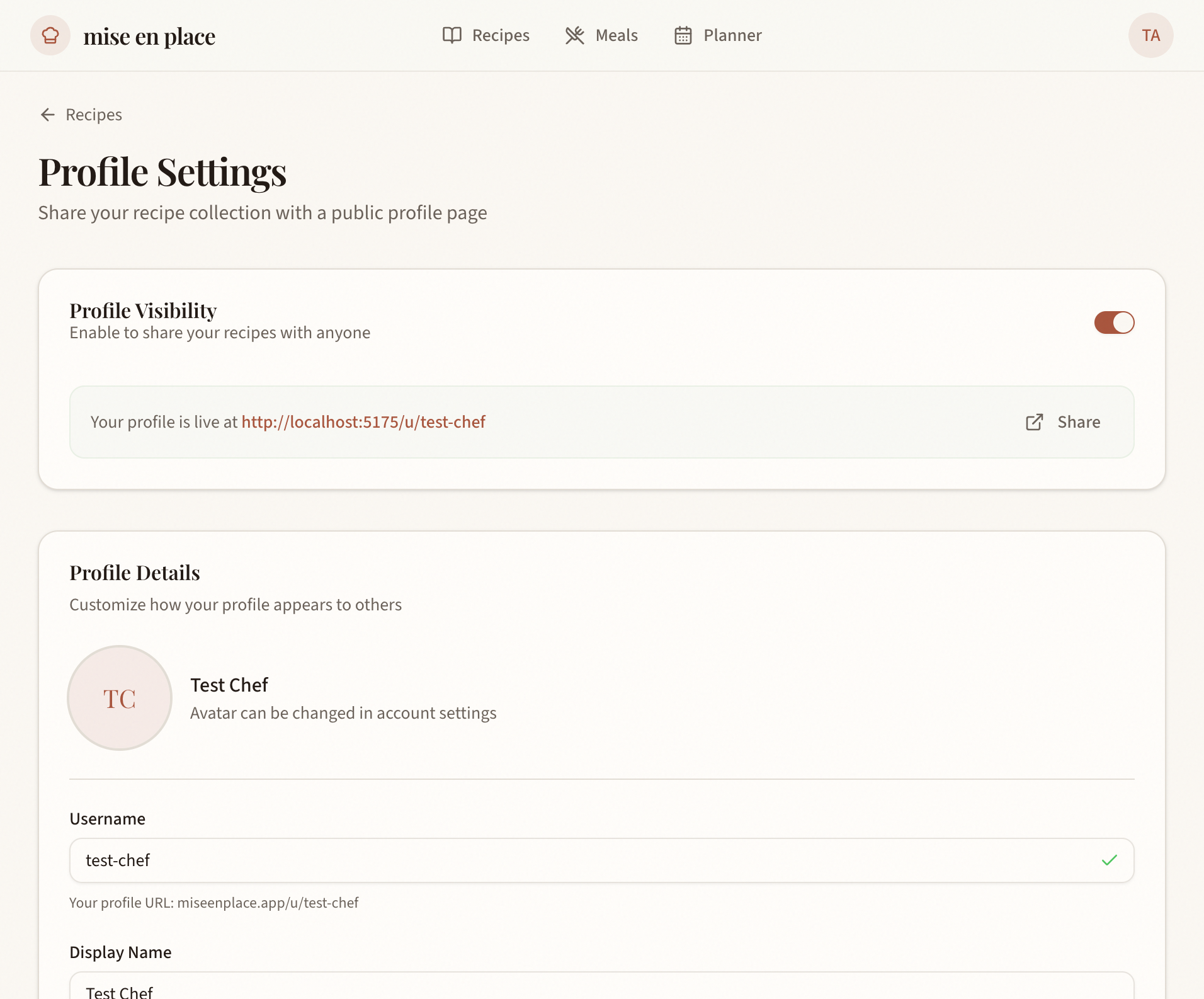
Profile Settings
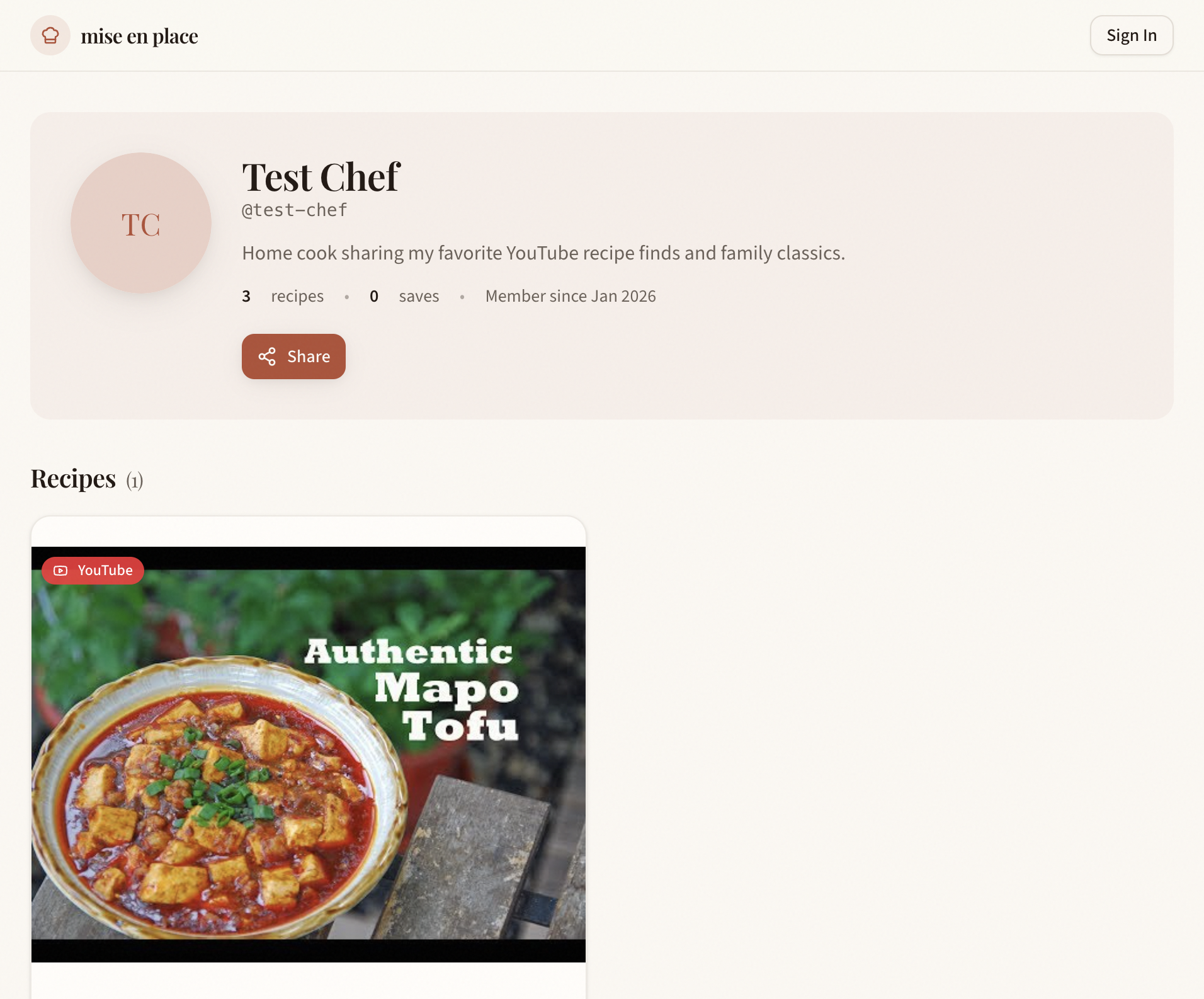
Users configure their public profile for sharing:
Profile Not Found
Graceful handling when profile doesn't exist or isn't public:
Conclusion
The 100% AI-Driven Workflow transformed a vague requirement ("share meal plans") into:
- 3 database tables with proper foreign keys and indexes
- 985 lines of repository code with error handling
- 312 lines of type-safe API routes
- 5 UI components following the project's design system
- 3 new pages integrated into routing
- 18 E2E tests with visual evidence
- 1,066 lines of documentation
All in ~25 minutes.
The key insight: each phase produces artifacts that the next phase consumes. Skip a phase, and downstream work suffers from missing context.
┌─────────────────────────────────────────────────────────────────┐
│ Traditional: Idea → Code → Debug → "Oh we need docs" → Forget  │
├─────────────────────────────────────────────────────────────────┤
│ Workflow: Idea → Design Doc → Plan → Code → Tests → PR Ready   │
└─────────────────────────────────────────────────────────────────┘
Case Study created: February 3, 2026
Feature Branch: feat/public-meal-plan
Commit: d55c8bb — "feat: Introduce public meal plan templates with sharing and import functionality"
Written by
